
If you’ve ever spent a Saturday on your back underneath a trailer, tracing a short circuit through rusted grounds, zip-ties, and cracked copper wires, you already know why wireless trailer lights exist. Modern setups completely ditch the hardwiring headache for a simple, magnetic, portable system.
But when you hit the brakes in the cab, how does a wireless trailer light stuck to the back of a 30-foot trailer instantly know what to do?
It’s not magic—it’s a dedicated wireless link between your tow vehicle and trailer. Here is a look under the hood at how these systems talk to each other, what affects their range, and how to keep them running reliably on the highway.
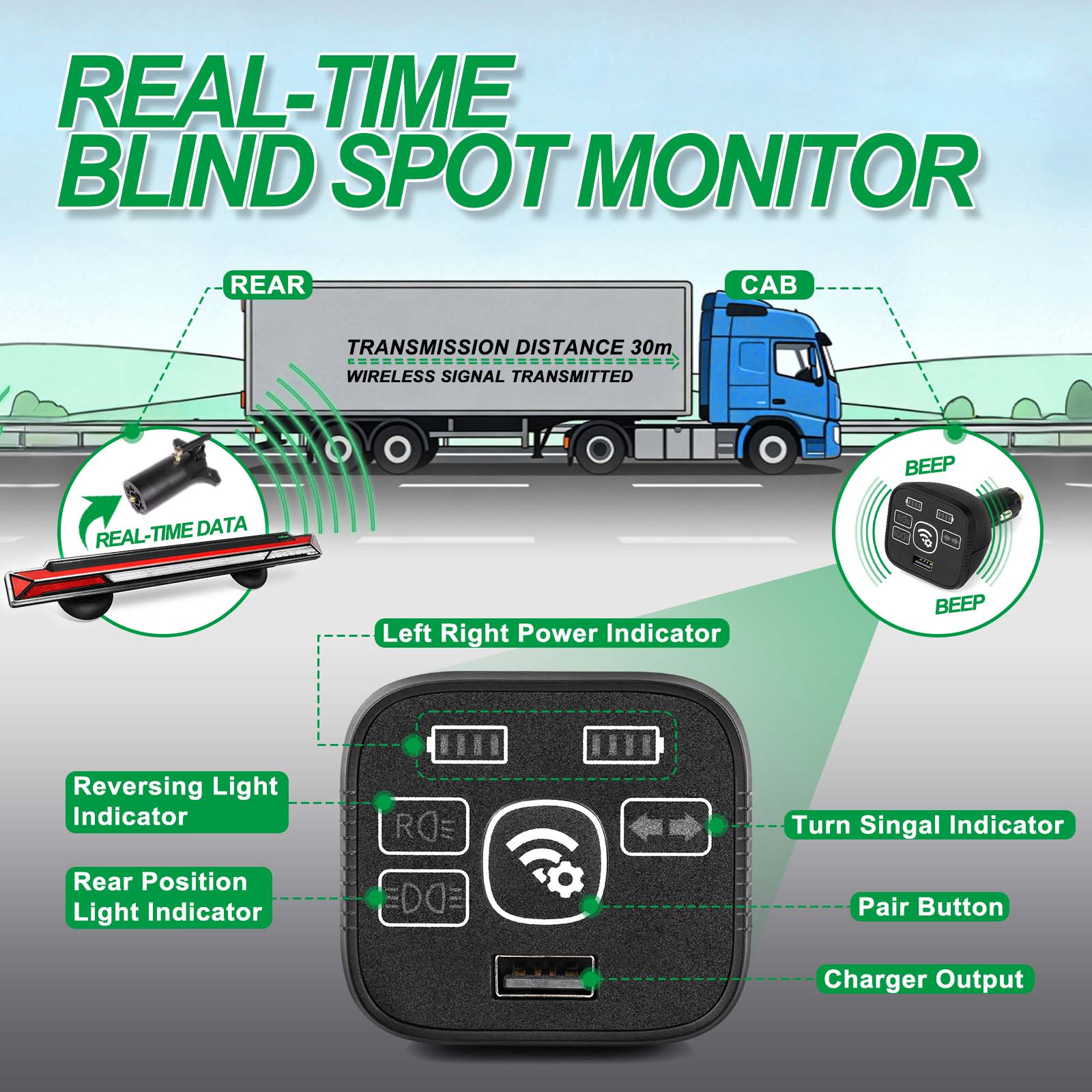
The 3 Pieces of the Puzzle
A wireless tow light setup strips the traditional wiring harness down to three basic parts:
- The Transmitter (The Brain): You don’t have to splice any wires. A small transmitter plugs directly into your tow vehicle’s 4-pin flat or 7-pin trailer socket.
- The Lights (The Listeners): These are the physical LED units mounted to the rear of the trailer. Inside the housing is a wireless receiver that listens for commands from the transmitter.
- The Power Source: Because there isn’t a wire running back to your truck’s alternator, the lights rely on internal rechargeable batteries to power the LEDs.
How the Signal Actually Travels
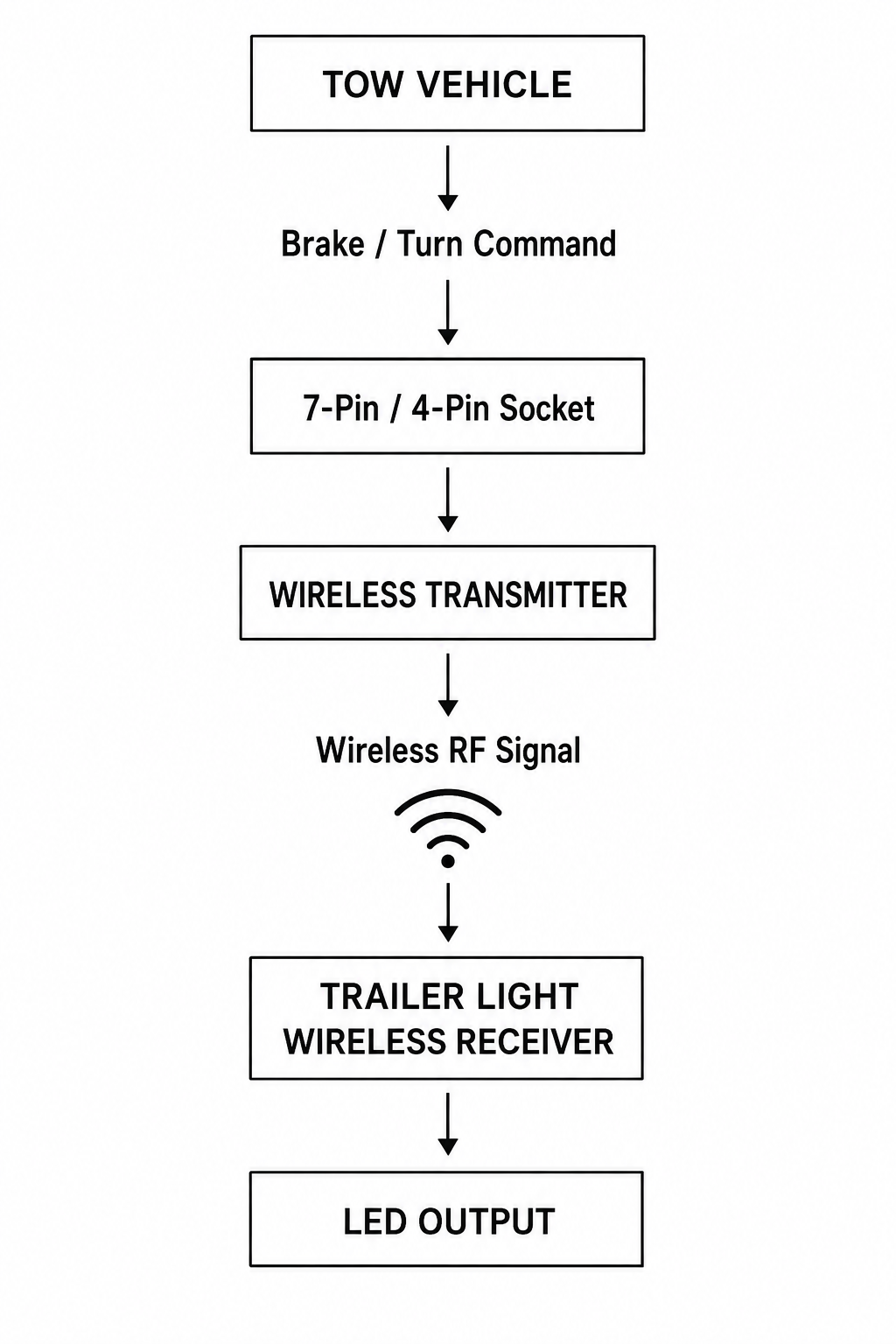
The entire process happens in a fraction of a second. In normal towing conditions, there should be no noticeable lag between your foot hitting the brake pedal and the trailer lights responding.
Here’s what happens when you hit the brakes:
- You take action: You step on the brake pedal or activate the turn signal. Your vehicle sends the corresponding electrical signal through the trailer connector.
- The translation: The plug-in transmitter detects the voltage change and converts that electrical command into a wireless radio-frequency signal.
- The broadcast: The transmitter sends the wireless signal toward the trailer-mounted lights.
- The reaction: The receivers inside the light housings detect the paired signal, decode the command, and activate the correct LEDs.
Real-World Range & Interference
Most commercial systems advertise a strong operating range, but laboratory testing and real-world towing are not always the same. Several factors can influence wireless performance:
- Heavy Metal: Radio-frequency signals can be affected by large steel structures. A massive enclosed cargo trailer may interfere with signals more than a low-profile flatbed or boat trailer. A clearer line of sight between the transmitter and rear lights generally helps.
- Recessed Hitches: If your truck’s 7-pin socket sits deep underneath a heavy steel bumper, surrounding metal may weaken the signal. A short compatible plug extension may help position the transmitter in a more open area.
- Battery Level: A low battery reduces available operating time and may eventually prevent the lights from functioning correctly.
How Far Can Wireless Trailer Lights Reach?
Signal range is not determined by distance alone. The effective reach of a wireless trailer light system depends heavily on three main factors:
- Distance: The physical distance between the tow vehicle’s trailer socket and the lights mounted at the rear of the trailer.
- Trailer Construction: Solid metal bodies, enclosed cargo walls, and thick steel frames can block, absorb, or reflect wireless signals.
- Transmitter Placement: A transmitter positioned with a clearer signal path will generally perform better than one hidden behind thick steel or other obstructions.
4 Pro Tips for the Road
- Check the Connection: A loose connection at the tow vehicle can cause intermittent operation. Make sure the transmitter is fully and securely inserted into the trailer socket.
- Cap the Charging Ports: If your lights charge through USB, make sure the rubber charging-port covers are pressed completely into place. An improperly sealed port may allow road spray and moisture to reach the electronics.
- Test Before Towing: Always perform a quick walk-around before entering traffic. Test the running lights, left and right turn signals, brake lights, and hazard lights.
- Watch the In-Cab Monitor: If your system includes a real-time monitor, use it to keep track of light status, battery condition, and potential signal interruptions while towing.
Taking It Further: The AgriEyes Approach
Wireless technology removes much of the inconvenience associated with traditional trailer wiring, but real-world towing also requires durable hardware, reliable power, and clear system feedback. That is where different wireless trailer light designs begin to stand apart.
AgriEyes AG-T328 Wireless Towing Light Bar
The AgriEyes AG-T328 Light Bar integrates solar charging to help maintain battery power during daylight use, while combining magnetic mounting, steel safety tethers, and in-cab monitoring for practical everyday towing.
AgriEyes T327C Wireless Magnetic Trailer Light Kit
The AgriEyes T327C Kit combines an IP67-rated weather-resistant design with magnetic mounting and real-time signal feedback to the in-cab monitor.
Frequently Asked Questions
Do I need to splice any wires on the trailer?
No. Wireless trailer light systems are designed to eliminate the need to run a traditional lighting harness along the trailer. The transmitter plugs into the tow vehicle’s trailer socket, while the wireless lights mount at the rear of the trailer.
Is there a delay when I hit the brakes?
Quality wireless systems transmit commands extremely quickly. During normal towing, the response should be fast enough that any delay is not noticeable to the driver.
Will enclosed trailers block the signal?
Large enclosed trailers can affect wireless signal performance because metal structures may block or reflect RF signals. Actual performance depends on the trailer construction, transmitter placement, system design, and towing distance.